
Bringing boulders back to the River Wye

The Upper Wye Catchment Restoration Project is working to restore the health and resilience of the upper River Wye Special Area of Conservation (from the source to Hay on Wye).
At Llangurig in the upper reaches, we’re restoring an important seven-kilometre stretch of the River Wye by reintroducing boulders to sections of the river where they have historically been removed.
In this blog, Project Managers, Brendan and Henry, explain why we’re putting boulders back into the Wye, what difference they can make for the river and its wildlife, and how this work fits alongside wider restoration activity around Llangurig.
Why are we returning boulders to the River Wye?
Boulders are a natural feature of upland rivers such as the Upper Wye. Over time, many were removed from the river, leaving some sections with a lack of flow variety and fewer of the natural features that provide habitat for fish and other wildlife.
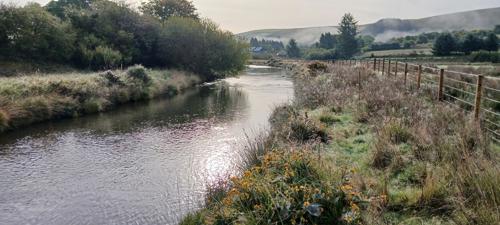
Photo: A stretch of the River Wye where boulders have been removed over generations
At Llangurig, we want to restore some of that natural variation that leads to a more diverse and healthier river.
Before any work began, we spent two years carrying out baseline surveys and reviewing monitoring data to develop our understanding of the river in its current form. This included looking at fish, aquatic invertebrates and the physical characteristics of the river channel.
The information we gathered has helped us identify where returning boulders could provide the greatest benefit.
How do boulders change a river?
When a boulder sits within a river channel, water can no longer simply flow straight along the riverbed. It has to move around and over the boulder, creating differences in flow speed, depth and water conditions.
When a number of boulders are placed within a stretch of river, these effects interact to create a more varied channel.
At Llangurig, the boulders have been placed in an irregular pattern, emulating nature, to create a mixture of faster and slower flows, pools, riffles and areas of quieter water.
This physical variety is important because different species and life stages need different conditions.
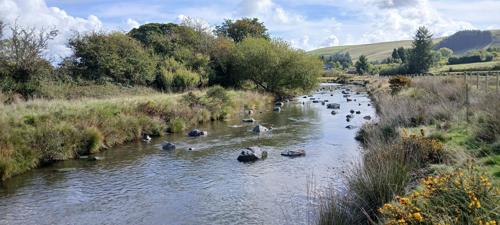
Photo: The same stretch of the River Wye following the reintroduction of boulders, creating greater variation in flow, water depth and habitat for fish and aquatic invertebrates
Creating better habitat for fish
One of the key reasons for the work is to improve habitat for Atlantic salmon (a designated species in the Special Area of Conservation) and trout.
Our monitoring has found abundant salmon fry in the area, but poor survival into the parr stage (age 1-4 years). A lack of boulder cover and varied habitat may be limiting their ability to feed, shelter and grow.
Boulders create areas of shelter from strong currents and predators, as well as deeper pockets of water and different feeding opportunities.
They also increase the physical diversity of the riverbed, creating a greater variety of habitats for aquatic invertebrates. These insects form an important part of the food web and provide food for fish and other wildlife.
By returning boulders to the river, we’re restoring some of the natural structure and complexity that makes a healthy river function as a living ecosystem.
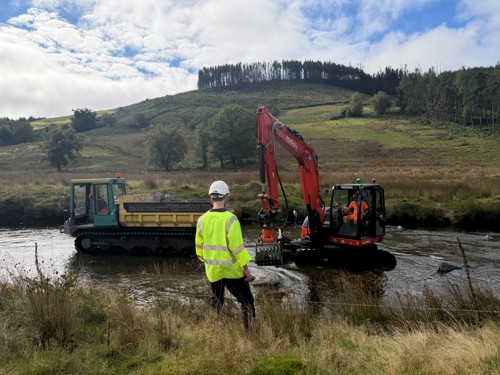
Photo: Work in progress – contractors positioning boulders within the channel
How does this fit with the wider work at Llangurig?
The boulder work is one part of a much wider programme of restoration taking place around Llangurig.
We’ve been working with farmers and landowners along this stretch of the Wye to deliver measures including riverside fencing, buffer strips and tree planting.
These measures help protect riverbanks, reduce soil and pollutants entering the river and provide future shade for the watercourse. Together, they address pressures coming from the surrounding land as well as those within the river itself.
Nearby at Tarenig Forest, we’ve also been carrying out slow-the-flow work using forestry offcuts in drains and ditches. This helps slow the movement of water through the landscape during periods of heavy rainfall.
Looking at the whole catchment is important because the health of a river is influenced by everything happening around it. By combining work in the river with measures on farms and across the wider landscape, we can address different pressures and build a more resilient river system.
What happens next?
With monitoring continuing, we’ll be looking at changes in fish populations, aquatic invertebrates and the physical characteristics of the river, allowing us to compare data before and after the work.
This monitoring is particularly important for understanding whether the restored habitat is helping more young salmon survive and develop into parr.
Restoring a river is a long-term process, and we won’t see the full benefits overnight. But by combining detailed monitoring with practical action, we can help the River Wye recover some of the natural complexity that has been lost over time.
The boulders are just one part of that recovery and our wider work with farmers, landowners and partners to create a healthier and more resilient upper Wye for the future.
--
The Upper Wye Catchment Restoration Project is funded by Welsh Government’s Nature and Climate Emergency Fund, part of the Water Capital Programme, to restore the condition of the upper River Wye.
The overall aim of this project is to protect species and enhance habitats by addressing a range of pressures affecting the river.
To keep up to date with our work you can follow us on as Facebook, X (formerly Twitter) and Instagram, or view our project newsletters here.
To find out more about the project, email us at RestoreUpperWye@naturalresources.wales